Machining Methods for High-Precision Holes
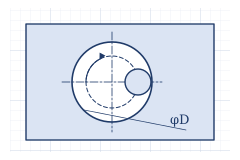
Our targets are 0.01 mm for diameter and ±0.05 mm for position. Depending on the hole size and required precision, we choose between drilling, helical milling, and boring. The cutting values are trial calculations and unverified on the actual machine.
Choosing the Right Method
| Hole | Process |
|---|---|
| φ12 or smaller, general | Center drill, drill (pilot hole if needed) |
| Larger than φ12, general | Helical milling with an end mill |
| High precision required | Leave finishing stock with a pilot hole or helical milling, then finish with boring |
| Large threads | Pilot hole with helical milling, thread mill |
| Method | Thrust | Effect of machine deflection | Hole position | Diameter and roundness |
|---|---|---|---|---|
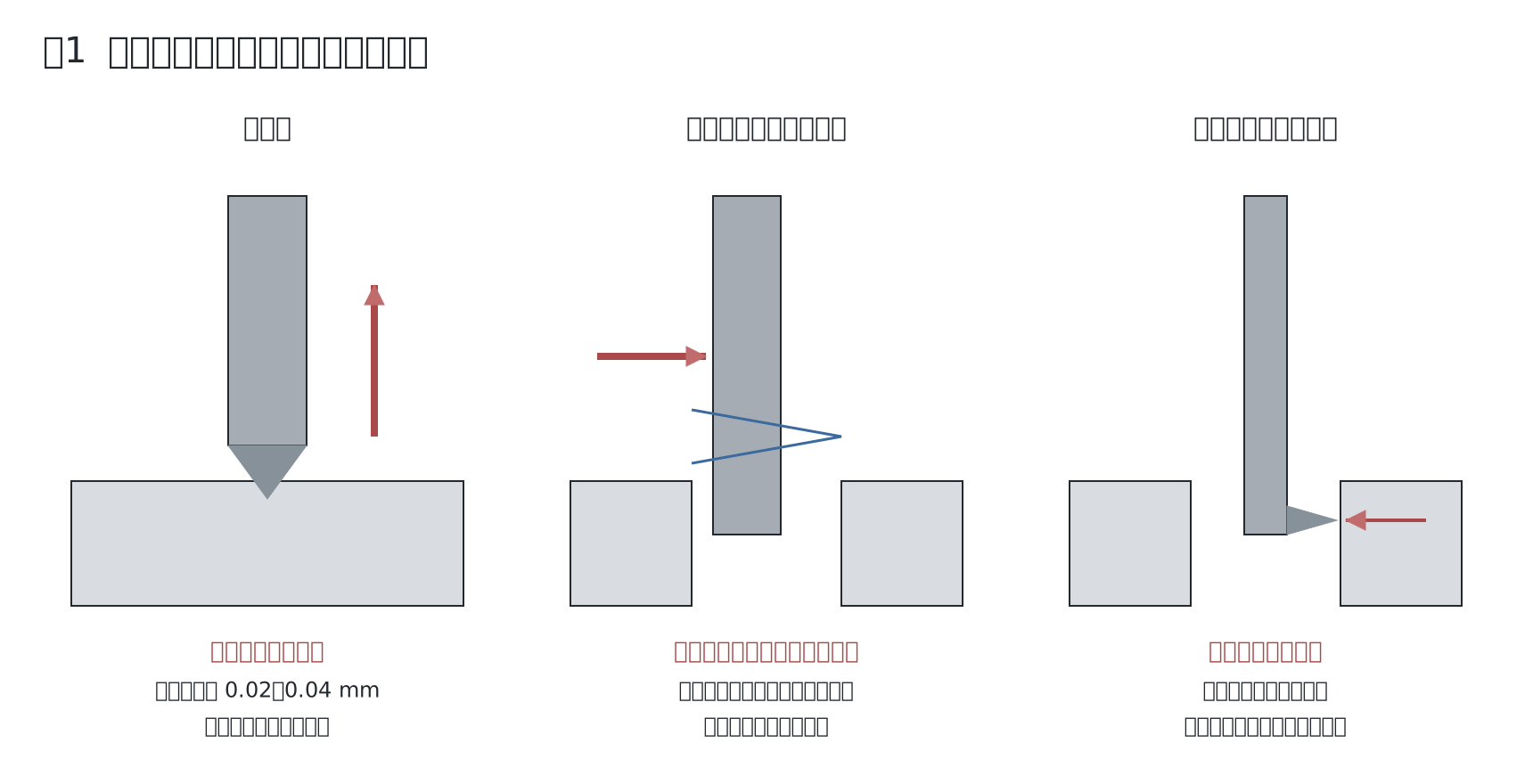
| Drilling | High (0.7 to 1.5 kN) | Tilts by 0.02 to 0.04 mm | Influenced by tool bending and tilt | Dependent on the tool |
| Helical milling | Low | Shows up as a difference in diameter | Determined by the program | Around 0.01 to 0.03 mm (verified by tests) |
| Boring | Very low | Slight | Determined by the program | Adjustable |
Effect of a Pilot Hole
Drilling a pilot hole keeps the center of the drill tip (the chisel edge) from cutting, which reduces thrust to about 1/3. For the cutting lips, Ft = 57 × (D − d) [N] (feed 0.07). Torque does not drop very much. Some tools do not allow the use of a pilot hole, so make sure to check beforehand.
| Process | Thrust | Torque |
|---|---|---|
| φ12 in one pass | 1000 to 1400 N (expected) | 2.4 N·m |
| φ4 pilot hole | 340 to 460 N (expected) | 0.27 N·m |
| φ12 (with φ4 pilot hole) | 456 N | 2.1 N·m |
| φ25 (with φ12 pilot hole) | 741 N | 8.0 N·m (exceeds rated 6.36 N·m) |
Helical Milling
Example: Machining a φ25 hole with a φ16 carbide end mill. Aim for a removal rate of 5,000 mm³/min.
- Power: 2000 × 5,000 / 60,000,000 = 0.17 kW, spindle speed: about 2000 rpm, torque: 0.8 N·m, tangential force: about 100 N. This is significantly lower than the 10.4 N·m for a φ25 drill.
- Since the direction of the force rotates along with the tool, deflection tends to make the hole diameter smaller, making it hard for the center to shift. Taking a light final pass around the hole reduces ovality.
- Use a tool thicker than half the hole diameter. It is not well-suited for deep holes. Air or coolant is required for chip evacuation.
Finish Boring
| Conditions | Cutting force |
|---|---|
| Depth of cut 0.2, feed 0.1 | 50 N, resultant force 56 N |
| Depth of cut 0.05, feed 0.05 (finishing) | 7.5 N, resultant force 8.4 N |
Lateral machine deflection is about 0.00013 mm/N, which works out to about 0.001 mm under finishing conditions. Dial in the diameter using test cuts and measurements. At φ30 and a cutting speed of 100 m/min, the spindle speed is about 1060 rpm.
Position within ±0.05 mm
Position is determined more by the feed axes than by deflection. The lead error of a C7 ballscrew is around ±0.05 mm per 300 mm (a typical value), so compensation is required over a 640 mm range.
| Error factor | Expected mm (assumed) | Countermeasure |
|---|---|---|
| Lead error (after compensation) | 0.015 | LinuxCNC pitch error compensation |
| Backlash in guides and screws | 0.010 | Preloaded nuts, measurement |
| Deflection during boring | 0.005 | Light finishing conditions |
| Alignment between machine and workpiece | 0.010 | Measure reference holes with a probe |
| Temperature (1 °C, 640 mm) | 0.007 | Remeasure the reference after continuous machining |
| Effect of spindle runout | 0.003 | Receiving inspection |
| Total | RSS approx. 0.022, simple sum 0.050 |
If we apply all countermeasures, we expect to reach the target, but the margin is small. For pitch error compensation, we drill a series of holes in a test plate, measure the spacings with a measuring tool of known accuracy, enter them into the compensation table, and drill again to verify. One idea is to ask an outside contractor or a public industrial research institute to use a coordinate measuring machine.
Verification Tests
- Helical mill a φ25 hole in SS400. Measure roundness and diameter.
- Compare results at different spindle heights.
- Finish with boring. Measure diameter adjustment, roundness, and surface roughness.
- Measure hole intervals to verify the effect of compensation.
Example of Required Tools
Fine-tuning boring head set NBH2084 (about ¥30,000 on AliExpress listings), φ12 and φ16 carbide end mills. Boring bars are heavy and bulky, so we change them by hand instead of putting them in the rack.
QR code for this page
https://robo100.jp/en/000016
No comments yet.